
Overview
EFNotes (ExecNotes) is a native Apple-ecosystem note-taking application built for macOS and iOS, developed as a venture of Studio Management. The product was designed to feel deeply integrated with Apple workflows — fast, keyboard-first on desktop, gesture-intuitive on mobile, and seamlessly synced across devices.
I joined EFNotes in 2024 as an early team member during the early product build phase. I worked as the Founding Product Designer, collaborating closely with the core team to design and ship the first MVP across macOS and iOS.
As Founding Product Designer, I owned research, interaction design, and information architecture, while building EFNotes' core systems — including Search, Tags, and the structured editor. I also contributed to roadmap strategy, cross-team alignment, and helped shape the product's native macOS and iOS experience.
The Core Problem
Most productivity tools assume users will:
- Carefully plan their information architecture
- Consistently organize content
- Regularly process and clean up notes
In reality, knowledge workers are rushed, overloaded, and context-switching constantly.
The biggest friction in note-taking isn't organization.
It's input.
Product Vision
EFNotes is built on a simple belief: Capture should reduce cognitive load in the moment, and retrieval should feel effortless . We built the product around three principles that make this possible.
1. Extreme Availability
Anything a user needs should be one interaction away.
Manifested through:
- Always-ready ThoughtPad block
- Global Search access
- Slash commands
2. Maximum Efficiency, Minimum Effort
We remove micro-frictions instead of adding complexity.
Examples:
- Auto-import screenshots
- Record audio on the go using the Watch app — it automatically transcribes and syncs to your system.
- Keyboard shortcuts
3. Context is King
- We help users avoid context switching by integrating capture, tasks, and media.
- We also preserve structural context inside Search results — hierarchy is never flattened.
Research, Strategy & Flows
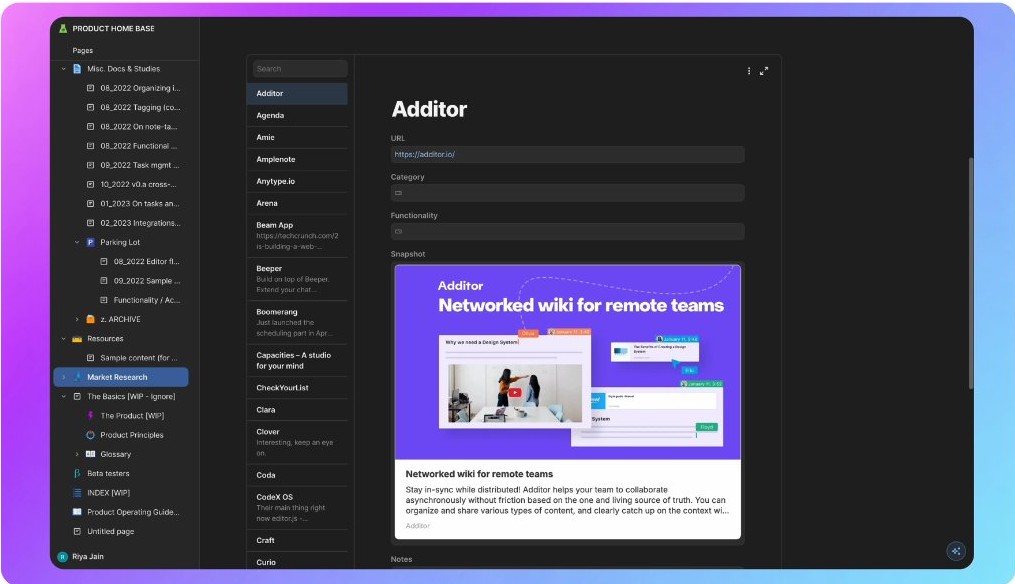
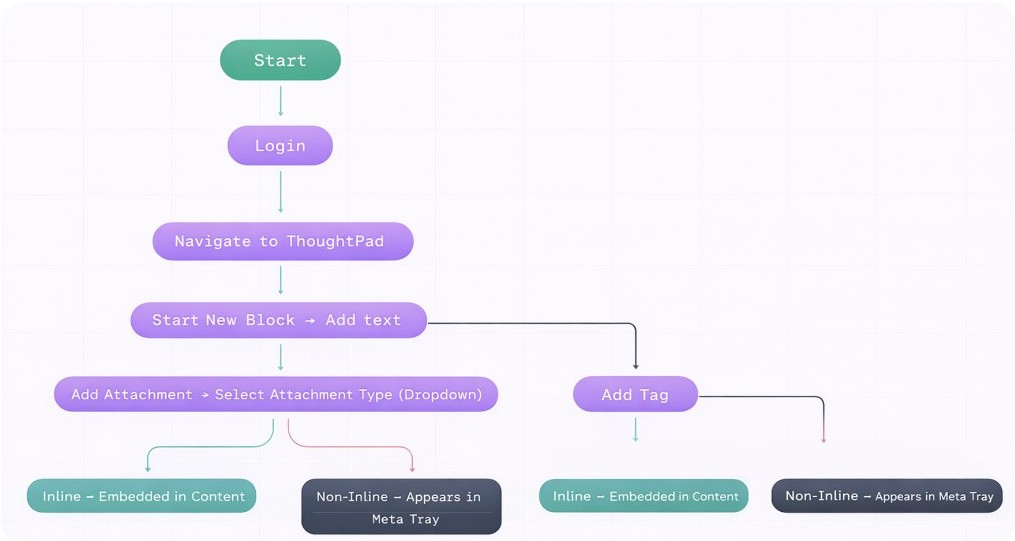
Before moving into interface design, I focused on understanding the problem space through competitive benchmarking, journey reframing, and systems-level flow mapping. This phase involved analyzing existing patterns, identifying friction points, and redefining user pathways to align with both business and user goals.
Below are snapshots of product flows, user journey maps, whiteboard explorations, and research documentation that informed key design decisions. These artifacts illustrate how structured thinking, clarity, and systems-level reasoning shaped the final experience.
They include research walkthroughs, roadmap documentation, early explorations, and detailed journey mapping — offering insight into both the strategic foundation and the iterative evolution of the product.
Intermediate Prototype
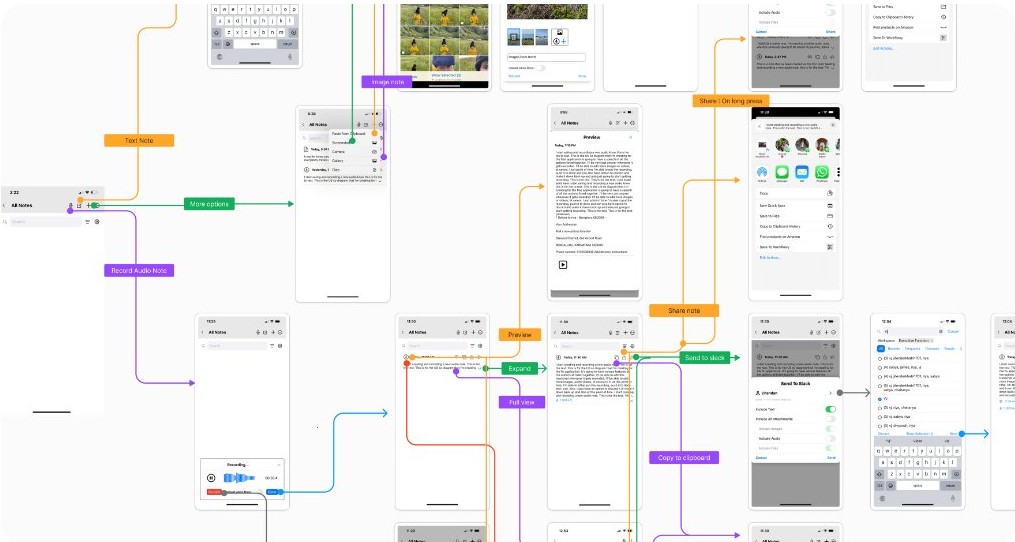
Before building the final product, we developed an intermediate prototype focused purely on experimentation — not UI polish.
The goal was to explore what was possible with different information formats and integrations. It also helped the developers understand technical feasibility, constraints, and trade-offs — especially in terms of engineering complexity, infrastructure, and budget.
In this version, users could create notes containing text, images, audio, and files. A major focus was testing audio — understanding how voice could be added, stored, and structured alongside written content.
We also experimented with a Slack integration, allowing notes (with media attached) to be shared directly to Slack to explore collaborative workflows.
This phase helped us validate multi-format flexibility, identify technical and budget boundaries early, and shape more informed decisions for the final product direction.
Product
Before building the final product, we developed an intermediate prototype focused purely on experimentation — not UI polish.
The goal was to explore what was possible with different information formats and integrations. It also helped the developers understand technical feasibility, constraints, and trade-offs — especially in terms of engineering complexity, infrastructure, and budget.
In this version, users could create notes containing text, images, audio, and files. A major focus was testing audio — understanding how voice could be added, stored, and structured alongside written content.
We also experimented with a Slack integration, allowing notes (with media attached) to be shared directly to Slack to explore collaborative workflows.
This phase helped us validate multi-format flexibility, identify technical and budget boundaries early, and shape more informed decisions for the final product direction.
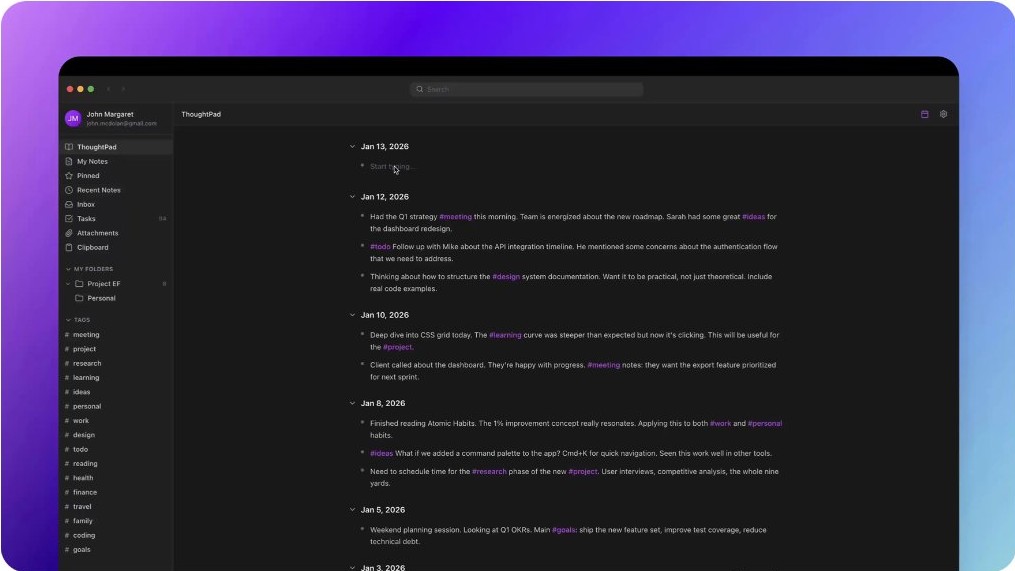
ThoughtPad is a space to instantly capture whatever's on your mind — without worrying about organizing it first.
Search is available on every page, allowing users to change the scope at any time.
Support multiple format — text, images, screenshots, audio (with automatic transcription), video, files.
Watch Audio Recordings —Capture thoughts or meetings on the go using the watch app. Audio recordings automatically sync to ExecNotes and are transcribed for quick reference.
Project Management & Execution
Beyond product design, I also played an active role in managing execution. I structured and maintained our workflows in Linear — defining initiatives, feature roadmaps, projects, and milestones to ensure clarity across the team. I created and managed planning documents, onboarding materials, Google Sheets trackers, and documentation systems that supported alignment between design and engineering.
Learnings
Building EFNotes from the ground up taught me how important it is to think beyond individual screens and focus on systems. Working in an early-stage environment required balancing speed with long-term architectural thinking, making decisions that would scale while still enabling us to ship quickly. This experience strengthened my ability to translate ambiguous problems into structured product systems, collaborate closely with engineering, and design solutions that reduce friction for users while remaining simple and intuitive.